Imagine launching a brand new Google Ads campaign for your Auckland plumbing business, only to watch your daily budget vanish before morning tea. For many Kiwi business owners, this is a frustrating and expensive reality in 2026. The digital advertising landscape has become fiercely competitive, driving up the cost of every single click and squeezing profit margins across the board. If you are tired of unpredictable marketing expenses and diminishing returns, conducting a thorough PPC Cost Comparison is your first step toward regaining control.
Understanding exactly where your marketing dollars go allows you to make smarter, more profitable decisions. It is no longer enough to simply throw money at a search engine and hope for the best. By analyzing industry benchmarks and hidden fees, you can identify which platforms actually deliver a positive return on investment. Furthermore, you will discover that paid ads are not the only way to generate high-quality visibility in New Zealand.
Key Takeaways
A comprehensive PPC Cost Comparison reveals that average Google Search CPCs now exceed $8.00 NZD, while platforms like LinkedIn charge premium B2B rates. Because paid ad costs are highly volatile, Kiwi businesses are increasingly turning to fixed-cost visibility solutions, like manual directory listings, to stabilize their marketing budgets.
Understanding PPC Advertising: How Are Costs Calculated?
Before diving into specific numbers, it is crucial to understand the underlying mechanics behind pay-per-click pricing. Every time a user searches for a service online, an invisible, split-second auction takes place. Advertisers actively bid against each other for the top promotional spots on the search engine results page.
However, the highest bidder does not automatically win the number one position. Search engines like Google utilize a complex metric known as Ad Rank to determine ad placement. This formula multiplies your maximum bid by your Quality Score, effectively leveling the playing field for smaller businesses.
Your Quality Score is determined by the relevance of your ad copy, your chosen keywords, and the user experience on your landing page. If your Quality Score is exceptionally high, you can actually pay less per click than a competitor who bids more but has a poorly designed website.
Despite the Quality Score system, the baseline cost of entering these digital auctions has skyrocketed globally. Recent data shows that the average cost-per-click (CPC) has increased across 87% of industries over the last two years alone. This means that simply maintaining your current traffic levels will require a significantly larger budget year over year.
For small New Zealand businesses, this continuous inflation makes relying solely on PPC a risky long-term strategy. When utilizing various ROI & Value Tools to measure your marketing effectiveness, you will often find that paid ads deliver diminishing returns as market saturation increases. This is why a comprehensive PPC Cost Comparison is absolutely essential for modern budget planning.
PPC Cost Comparison: Google Ads vs. Social Media Networks
When allocating your digital marketing budget, you must carefully choose between search intent platforms and interruption marketing networks. A detailed PPC Cost Comparison highlights massive differences in how these various platforms charge advertisers. Google Ads captures users who are actively looking for a solution, while social media networks display ads to users based purely on their interests and demographics.
Understanding this fundamental difference in user psychology is key to interpreting the varying costs. High intent always commands a premium price tag. Conversely, passive browsing environments offer cheaper clicks but require more sophisticated sales funnels to convert that traffic.
Google Ads Pricing: Search vs. Display Networks
Google Search is the gold standard for capturing high-intent leads. When someone types “emergency electrician Wellington” into Google, they are ready to buy immediately. Because of this high purchase intent, Search network clicks are expensive, averaging around $5.26 USD globally, which translates to over $8.30 NZD.
In stark contrast, the Google Display Network places visual banner ads on third-party websites across the internet. These clicks are significantly cheaper, often averaging just $0.63 USD per click. However, the conversion rate on Display ads is much lower because users are busy reading articles or browsing forums, not actively shopping for your specific services.
Paid Social Costs: Facebook, Instagram, and LinkedIn
Social media advertising operates on a completely different psychological trigger. You are interrupting a user’s scrolling experience with a compelling visual offer. Facebook and Instagram ads remain relatively affordable, with average CPCs hovering between $1.11 and $1.72 USD.
These visual platforms are excellent for consumer goods, local brand awareness, and highly aesthetic products. However, the leads generated often require extensive follow-up, as the user was not actively searching for a solution when they clicked your ad.
LinkedIn, on the other hand, is the undisputed king of B2B advertising. Because you can target users by their exact job title, company size, and industry, LinkedIn charges a massive premium for access to its professional audience. You can expect to pay upwards of $5.58 USD per click on LinkedIn. While the clicks are costly, the lifetime value of a B2B contract often justifies the steep initial investment.
Average CPC Benchmarks: Industry-Specific PPC Costs
Your specific industry plays the biggest role in determining your overall advertising costs. A standard PPC Cost Comparison is virtually useless without context, as a local cafe will never pay the same CPC as a corporate law firm. Highly competitive markets with high customer lifetime values inevitably face brutal bidding wars.
To truly understand where your business stands, you must look at industry-specific data. The cost to acquire a customer in the technology sector is vastly different from the cost in the health and wellness space. Below is a breakdown of how different sectors fare in the modern digital auction.
| Industry Vertical | Average Google Search CPC (USD) | Competition Level |
|---|---|---|
| Legal & Attorneys | $8.58+ | Extreme |
| Business Services & B2B | $5.58 | High |
| Trades & Home Property | $4.50 – $6.00 | High |
| Retail & Ecommerce | $2.50 – $3.50 | Medium |
| Arts & Entertainment | $1.60 | Low |
If you operate in the legal, financial, or emergency trades sectors, be prepared for brutal bidding wars. A single click can cost over $15 NZD, meaning a poorly optimized campaign will literally drain your budget in hours.
On the lower end of the spectrum, arts, entertainment, and tourism businesses enjoy much more affordable CPCs around $1.60 USD. Ecommerce businesses also see varied costs depending on their specific niche, though the rise of Google Shopping and Performance Max campaigns has fundamentally altered how online stores bid for visibility.
Ultimately, if your CPC exceeds your profit margin on a single sale, your campaign will bleed money rapidly. You must calculate your break-even point meticulously before launching any paid campaign in a high-competition vertical.
Hidden Fees: The Real Cost of Managing Paid Campaigns
Looking at CPC benchmarks only tells half the story of your true marketing expenses. When conducting a realistic PPC Cost Comparison, you must account for the hidden fees inherently associated with running a professional campaign. Very few business owners have the time, patience, or expertise to manage complex bidding algorithms themselves.
Most New Zealand businesses end up hiring digital marketing agencies to manage their ad accounts. Agency management fees typically range from $1,000 to $5,000+ NZD per month, depending entirely on the complexity and scale of the campaign. This management fee is entirely separate from the actual budget you pay directly to Google or Meta for the clicks.
Review your monthly marketing invoices carefully. Ensure you know exactly what percentage of your budget is going toward actual ad clicks versus agency management retainers and software subscriptions.
Furthermore, you must factor in the devastating cost of “curiosity clicks” and wasted ad spend. If your targeting is even slightly off, you will pay for clicks from users who have absolutely zero intention of buying your product. The algorithms often require a “learning phase” where they burn through your cash simply to gather data on what does not work.
You also need to invest in supplementary tools to make the ads work. This includes landing page software, conversion tracking scripts, and professional ad copywriting to ensure those expensive clicks actually turn into paying customers. When you add all these costs together, the true price of PPC is often double the raw CPC data.
PPC Alternatives: Comparing Paid Ads to Directory-Based Visibility
With PPC costs continuing to climb relentlessly, smart Kiwi businesses are actively diversifying their digital presence. Relying 100% on paid ads is essentially like renting your online visibility; the exact moment you stop paying, your traffic drops to zero. This is where high-quality, trusted business discovery platforms come into play.
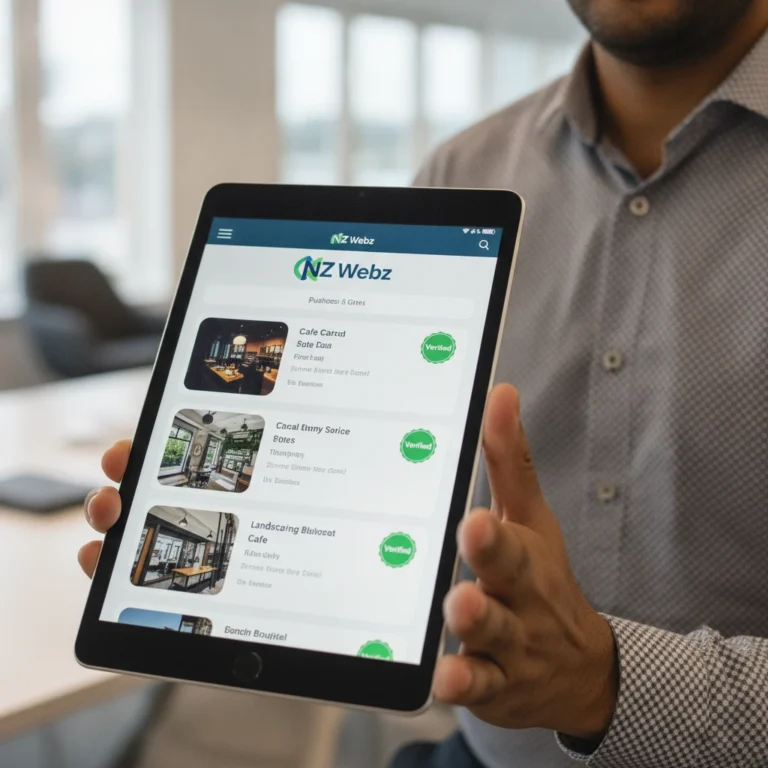
Unlike the highly unpredictable auction system of Google Ads, a premium listing on a platform like NZ Webz offers fixed-cost visibility. NZ Webz is a curated, family-owned New Zealand website discovery platform that manually reviews every single submission. This strict quality control ensures your business is placed alongside other verified, legitimate Kiwi companies, instantly boosting your credibility.
- Manual Quality Control: Every submission is reviewed by a human, eliminating automated spam bots and protecting platform integrity.
- Affordability: Value-priced, annual listing plans that completely eliminate the unpredictable month-to-month cash burn of PPC ads.
- Structured Discovery: Highly organized by 10 core verticals and exact NZ regions, ensuring localized visibility in Auckland, Wellington, or Queenstown.
For new startups or ecommerce stores with zero domain authority, being listed on a trusted, manually reviewed directory allows you to borrow credibility. Customers cross-reference multiple sites to build trust before buying.
By securing a structured business profile categorized by your exact NZ region, you create a permanent digital asset. This approach provides affordable, set-and-forget long-term visibility without the anxiety of monitoring daily CPC fluctuations. It perfectly complements your existing marketing efforts, offering a high-trust alternative to spam-filled web directories.
For local tradies, digital agencies, and startup founders alike, investing in manual directory visibility is a highly cost-effective strategy. While a PPC Cost Comparison proves that ads can provide a quick burst of traffic, platforms like NZ Webz help you build enduring, compounding brand awareness over time. By balancing your marketing mix, you protect your bottom line while reaching genuine customers across New Zealand.