
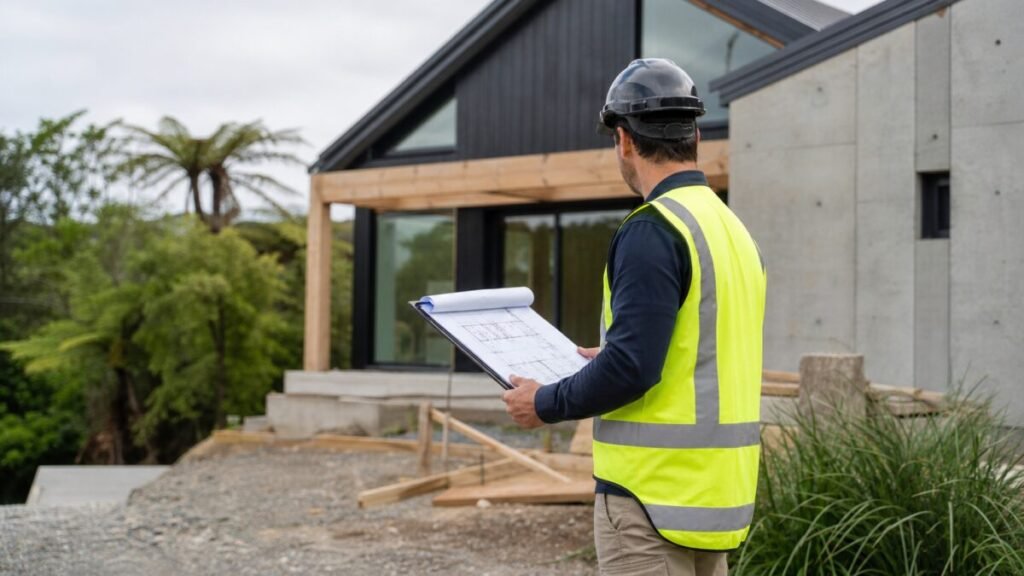
Start by verifying the builder holds a current Licensed Building Practitioner (LBP) licence on the MBIE public register, carries proper insurance, and provides all legally required documents including a written contract for jobs over $30,000 including GST. Then compare detailed quotes, check references from recent projects, and ensure the written contract covers scope, cost, timeline, and how variations are handled.
With construction costs ranging from $2,500 to $4,500 per square metre in 2026, choosing the wrong builder can cost tens of thousands in delays, poor workmanship, or legal disputes. This guide walks you through credentials, quotes, contracts, and red flags specific to New Zealand’s building industry.
Understanding Legal Requirements: The $30,000 Rule
For residential building work costing $30,000 or more including GST, New Zealand law requires three mandatory documents before work begins: a written contract, a disclosure statement outlining the builder’s business details and any conflicts of interest, and a prescribed checklist explaining your rights and responsibilities. These aren’t optional paperwork—they’re legal safeguards if disputes arise.
The disclosure statement reveals who you’re dealing with: company structure, directors, insolvency history, and whether the builder has any financial or personal interests that could affect the project. The checklist ensures you understand warranties, dispute resolution, insurance obligations, and your right to cancel within five working days of signing.
Even for jobs under $30,000, insist on a written agreement covering scope, cost, timeline, and payment schedule. Verbal agreements are difficult to enforce and leave both parties exposed to misunderstandings about what was promised.
Essential Credentials to Check
Most building work in New Zealand must be done or supervised by Licensed Building Practitioners. Verify any builder’s licence on the MBIE public register, which shows licence type, status, and disciplinary action. LBP licences come in categories—carpentry, foundations, roofing, external plastering, bricklaying, site work—so confirm your builder holds the right class for your specific job. A carpenter LBP can’t legally supervise foundation work.
Registered Master Builder membership provides additional assurance beyond the LBP licence. Members meet industry quality standards and access a guarantee scheme that protects homeowners if the builder goes bust or doesn’t complete the work. This membership isn’t legally required but indicates the builder commits to professional standards and dispute resolution processes.
Insurance is non-negotiable. Your builder must carry public liability and construction insurance and offer robust build warranties. Public liability covers damage to your property or injuries during the build, while construction insurance protects the project materials and work in progress. Warranties typically cover defects for 6–12 months after completion, though Master Builder guarantees can extend longer.
- Verify LBP licence on MBIE public register and check expiry date
- Confirm licence type matches your project scope
- Ask for proof of current public liability insurance (minimum $2 million cover)
- Request evidence of construction insurance for the project value
- Check Registered Master Builder membership status if claimed
- Confirm what warranties are offered and their duration
Getting and Comparing Quotes
Get at least three detailed quotes, and ensure each builder quotes on identical drawings, specifications, and assumptions. A quote 20% cheaper might exclude site preparation, scaffolding, council fees, or use lower-grade materials. You can’t compare prices fairly if builders are quoting different scopes.
For a standard three-bedroom home of 130–160m² in Auckland, expect construction costs of roughly $390,000 to $720,000 at mid-range build rates of $3,000–$4,500 per square metre. Budget an additional 10–12% for professional fees including architects, engineers, and surveyors on top of construction costs.
A detailed quote breaks down materials, labour, subcontractors, and provisional sums for items not finalised when quoting. Beware quotes that lump everything into one line—you can’t track variations or cost overruns without knowing what’s included. Ask builders to explain any significant price differences between quotes, which often reveal different assumptions about finishes, site conditions, or project complexity.
| Quote Element | What to Verify |
|---|---|
| Scope of work | Matches your plans and specifications exactly, room by room |
| Materials | Brand, grade, colour, and quantity specified for all major items |
| Labour | Breakdown showing who does what, hourly rates or fixed price per trade |
| Subcontractors | Named, licensed, insured (plumber, electrician, roofer, etc.) |
| Provisional sums | Clearly labelled allowances for tiles, fixtures, landscaping |
| Exclusions | What’s not included: driveways, fencing, appliances, landscaping |
| Timeline | Start date, key milestones, practical completion date |
| Payment schedule | Deposit amount, progress payment triggers, final payment holdback |
Checking References and Track Record
Ask for three recent references from projects completed in the past 12 months, similar to yours in size and complexity. Contact those homeowners directly—don’t just accept written testimonials—and ask specific questions: Did the builder finish on time and within the original budget? How were variations handled and priced? How did they manage unexpected problems like weather delays or site conditions? Would you hire them again, and if not, why?
Visit completed projects if homeowners agree. You’ll see workmanship quality, attention to detail, and whether the builder’s style matches your expectations. Examine joins, finishes, how well doors and windows sit in frames, whether tiles line up properly, and if paint coverage is even. Sloppy details indicate rushed work or poor supervision.
Check online reviews, but verify them carefully—a pattern of similar complaints across multiple platforms matters more than isolated negative reviews. Search the Companies Office register for the builder’s company to check for insolvency history, director changes, or other red flags. A company that’s changed names or directors frequently may be avoiding past problems.
When evaluating smaller regional builders, ask how they handle warranty work after project completion and whether they’ll still be available if issues arise. NZ Webz lists builders across New Zealand, including Home Concept Kerikeri for renovations and maintenance in the Far North, and CJ Building Services in Whangarei specialising in energy-efficient and passive homes in Northland. Regional builders often have strong local reputations you can verify through council building inspectors or local building suppliers.
What to Look for in a Written Contract
A comprehensive contract protects both parties by setting clear expectations. It must include the complete scope of work with plans and specifications attached, total cost broken down by category, payment schedule tied to specific milestones, start and estimated completion dates with provisions for delays, and a documented process for pricing and approving variations.
The contract should specify who obtains building consents, who manages and pays subcontractors, what insurance covers the project, and how disputes will be resolved. Include provisions for Code Compliance Certificates—the legal requirement from council confirming your home meets building code standards when work finishes. Specify that final payment is withheld until the CCC is issued.
- Full scope attached as drawings and detailed specifications
- Total cost with separate line items for materials, labour, consents, fees
- Payment schedule with percentages tied to completion stages, not dates
- Start date and estimated completion with weather delay allowances
- Variation process requiring written quotes and approval before work starts
- Builder’s responsibility to obtain consents and book inspections
- Insurance requirements and who pays premiums during construction
- Dispute resolution via mediation before legal action
- Warranties covering defects for specified period after completion
- CCC responsibility and conditions for final payment release
Pay close attention to the variation clause. Almost every building project involves changes, and you need a fair process for pricing them. Insist variations are documented in writing with a clear price and timeline impact before work proceeds. Avoid contracts allowing builders to charge time-and-materials for variations without price caps—this leads to budget blowouts.
Red Flags: What to Avoid
Some warning signs mean you should eliminate a builder immediately. A builder who can’t or won’t provide an LBP licence number, current insurance certificates, or recent references is either unlicensed, uninsured, or has unhappy clients. One who pressures you to sign immediately, offers substantial discounts for signing today, or wants to start work before contracts are finalised doesn’t respect legal requirements or professional boundaries.
Quotes significantly lower than competitors—20% or more—usually mean the builder has missed something major, plans to use substandard materials, or intends to recover profit through variation charges later. A builder who won’t commit to a timeline in writing or avoids documenting agreements will be impossible to hold accountable when problems arise.
- No LBP licence or refuses to provide verifiable licence number
- Can’t produce current insurance certificates within 24 hours
- Won’t provide contactable references from recent projects
- Pressures you to sign or pay deposit immediately
- Requests deposits over 10% or wants cash to avoid GST
- Quote is 20%+ lower than others with no clear explanation
- Won’t commit to timeline, price, or scope in writing
- Poor communication, slow responses, or defensive when questioned
- No physical office, registered address, or stable company history
- Negative pattern in online reviews about incomplete work or payment disputes
Poor communication during the quoting phase predicts worse communication during the build. If a builder takes days to respond to emails, doesn’t return calls, or provides vague answers to direct questions, those problems will magnify once they have your deposit and are juggling multiple projects.
Key Questions to Ask Your Builder
Before signing anything, ask questions revealing how the builder operates and whether they suit your project. Start with experience: How many projects like mine have you completed in the past two years? Can I see photos or visit those sites? Who will supervise daily work on site, and what are their qualifications?
Then address practical concerns: What’s your current workload and realistic start date? How do you handle weather delays or unexpected site conditions? What’s your process for managing subcontractors and ensuring they’re licensed and insured? How often will you communicate progress, and what’s the best way to reach you during the build? What happens if I’m not satisfied with work quality?
| Question | Why It Matters |
|---|---|
| What’s your LBP licence number and category? | Legal requirement you can verify on MBIE register |
| What insurance do you carry and for how much? | Protects you from liability and project loss |
| Can I contact three recent clients with similar projects? | Verifies track record and client satisfaction |
| Who will be on site daily and what’s their experience? | Ensures qualified supervision and quality control |
| How do you price and approve variations? | Prevents budget blowouts and payment disputes |
| What’s your payment schedule and what triggers each payment? | Fair terms protect both parties from financial risk |
| How do you handle defects discovered after completion? | Tests commitment to warranties and quality |
| What’s your process for obtaining consents and scheduling inspections? | Ensures legal compliance and smooth CCC process |
| How many other projects will you be running during mine? | Reveals capacity and attention your project receives |
| What happens if you can’t complete the project? | Checks guarantee scheme coverage and contingency plans |
Ask about quality control processes, building inspection procedures, and relationships with your local council. Builders working regularly in your area understand local requirements, have established inspector relationships, and know which subcontractors perform reliably. A builder new to your region may face longer consent times and unfamiliar site conditions.
For specialised trades within your build, note that painting is not a licensed trade in New Zealand. Look for Master Painters New Zealand membership, public liability insurance, and trained staff when evaluating painters your builder intends to subcontract.
Bottom Line
The right builder combines verifiable credentials—current LBP licence, proper insurance, Registered Master Builder membership—with a solid track record of completed projects and satisfied clients. Get three detailed quotes based on identical specifications, contact references directly, and insist on a comprehensive written contract covering scope, cost, timeline, and variation procedures before any money changes hands.
Choosing carefully now prevents expensive disputes, delays, and poor workmanship later. Allow several weeks to gather quotes, check credentials, and compare builders rather than rushing to start construction. Browse business categories or search by region on NZ Webz to find qualified builders, or submit your building business to connect with homeowners planning their next project.
Frequently asked questions
Do I need a written contract with my builder in New Zealand?
Yes, for any residential building work costing $30,000 or more (including GST), NZ law requires a written contract. The builder must also provide a disclosure statement and prescribed checklist before you sign.
What is a Licensed Building Practitioner and do I need one?
A Licensed Building Practitioner (LBP) is a builder licensed by MBIE to carry out or supervise most building work in New Zealand. You can verify any LBP's licence on the MBIE public register to confirm they're qualified for your project.
How much does it cost to build a house in New Zealand in 2026?
Building a house in New Zealand in 2026 costs about $2,500 per square metre for a basic build and $3,000 to $4,500 for an average home. A standard three-bedroom home (130-160m²) in Auckland runs roughly $390,000 to $720,000 for construction alone.
What insurance should my builder have?
Your builder must carry public liability insurance and construction insurance. They should also offer robust build warranties before you hire them to protect you against defects and ensure the work is covered if something goes wrong.
Sources
- building.govt.nz/assets/Uploads/projects-and-consents/Consumer-protection-checklist.pdf
- mortgagelab.co.nz/blog/how-to-choose-a-builder-nz
- superiorhomes.co.nz/how-much-to-build-a-house-nz
- jraconstruction.co.nz/custom-home-construction-checklist
- masterbuilder.org.nz/RMBA/building_and_renovating/get_your_building_project_started.aspx
- advancebuild.co.nz/top-5-tips-for-choosing-the-right-builder-in-new-zealand
- builderdirect.co.nz/building-cost-guide-nz
- buildingguide.co.nz/construction/choosing-a-builder
- superiorpainters.co.nz/house-painting/7-factors-to-consider-when-choosing-right-painting-contractors-in-auckland
Written by the team at NZ Webz. Checked November 2026.